What Makes a Good Wiring Harness Supplier?

Two wiring harness suppliers may offer similar prices. The differences often become apparent when a connector is unavailable, a drawing changes, or a production batch has a quality problem.
A good wiring harness supplier combines technical understanding, controlled manufacturing, consistent quality, reliable material sourcing, transparent pricing, and responsive customer support. It identifies risks early, explains limitations honestly, and helps buyers maintain the approved product configuration throughout prototype development and repeat production.
When discussing a custom harness project with a customer, I look at what could prevent the project from moving smoothly into production. A useful supplier relationship starts with making those risks visible, not simply promising a low price and a short lead time.
What Does a Good Supplier Show Before Quoting?
A quotation is often the first evidence of how a wiring harness supplier approaches a project. Its usefulness depends on how clearly it connects price, technical requirements, and manufacturing feasibility.
A good supplier reviews the application, drawings, BOM, component compatibility, and testing requirements before confirming a quotation. It identifies missing information, explains cost assumptions, and distinguishes confirmed material availability from estimates that still need verification.
What Are the Key Characteristics of a Good Wiring Harness Supplier?
A reliable supplier needs to understand more than how to cut wires and install connectors. Custom harnesses are built for specific applications, and the supplier's technical and commercial decisions can affect the customer's assembly line, inventory, and after-sales service.
The following characteristics are useful indicators of a good supplier. The relative importance of each depends on the application and the customer's requirements.
| Supplier characteristic | What good performance looks like | Why it matters to buyers |
|---|---|---|
| Technical understanding | Reviews drawings, pinouts, components, and interfaces | Reduces specification errors before sampling |
| Engineering support | Identifies design and manufacturing constraints and proposes documented options | Helps resolve problems before production |
| Material sourcing | Checks exact part numbers, availability, and approved sources | Reduces unexpected delays and substitutions |
| Manufacturing capability | Uses suitable tooling, fixtures, and controlled instructions | Supports repeatable assembly |
| Quality control | Defines inspections and tests for the actual product | Provides evidence of conformity |
| Delivery reliability | Provides realistic schedules and communicates risks early | Helps customers plan inventory and production |
| Pricing transparency | Explains quantities, included processes, and separate charges | Makes purchasing costs easier to compare |
| Change management | Documents revisions and obtains required approvals | Prevents unapproved changes in repeat orders |
| Customer support | Responds to technical questions and follows up on quality issues | Helps resolve problems throughout the supply relationship |
A supplier does not need to manufacture every type of wire harness to be a good partner. A factory specializing in simple replacement assemblies may be a better fit for a particular distributor than a larger factory focused on complex vehicle programs. What matters is whether the supplier has relevant capabilities and can demonstrate them for the intended product.
How Does a Good Supplier Handle Incomplete Technical Information?
Customers do not always have a complete technical package when they first request a quotation. Some provide an approved drawing and bill of materials (BOM). Others have a preliminary design, an existing harness, or a photograph of a discontinued replacement part.
A useful supplier distinguishes what is known from what still needs confirmation. It should not interpret missing specifications as permission to make arbitrary choices.
Consider an industrial harness with a sealed connector. The BOM specifies a housing and a secondary lock, but the assembly drawing does not clearly show the lock. The supplier needs to confirm whether the accessory is required, whether it is included in the housing assembly, and which version the customer has approved.
A similar issue can arise when wire color is specified but conductor construction or insulation diameter is missing. The wire may need to fit both a terminal and a seal. Selecting it by color and gauge alone can create a compatibility problem.
A constructive technical review can identify:
- Missing connector, terminal, or seal part numbers.
- Differences between the drawing, BOM, and pinout.
- Unclear measurement points, branch lengths, or tolerances.
- Components that may be difficult to source or process.
- Installation or testing requirements that need customer confirmation.
The manufacturer can propose practical solutions, but the customer or designated engineering authority should approve changes to the customer's specifications. This distinction is especially important when a proposed solution affects the mating interface or electrical function.
At AMBET, we can provide a reference quotation for an incomplete RFQ with the assumptions stated. Identifying those assumptions helps both sides understand what still needs to be confirmed before a production commitment is made.
What Does a Transparent Wire Harness Quotation Look Like?
A low unit price tells a buyer very little if the underlying specification is unclear. Two quotations may appear to cover the same harness while using different connectors, inspection methods, or packaging arrangements.
A useful quotation identifies its technical and commercial basis.
| Quotation item | What should be clear |
|---|---|
| Product specification | Part number, drawing revision, and applicable BOM |
| Components | Specified materials and any proposed alternatives |
| MOQ and price | Quantity per finished part number and corresponding unit price |
| Samples and tooling | Included work and any separately quoted development or fixture charges |
| Inspection | Required tests and documentation included in the offer |
| Delivery | Material availability, expected lead time, and conditions for starting production |
| Packaging | Standard packing or customer-specific requirements |
| Open items | Assumptions, unresolved technical questions, and who needs to confirm them |
An offer based on an available connector is not the same as an offer based on a future component purchase. If availability is unconfirmed, that should be reflected in the quotation or delivery estimate.
Good suppliers also explain when a change in the quantity, design, or test requirements could affect the price. The goal is not to eliminate every possible adjustment but to avoid surprises after the order has been placed.
Which Evidence Is Tied to Your Actual Part?
A quality management certificate, factory brochure, or product photograph can provide background information. None of them, by itself, proves that a particular harness will meet the customer's requirements.
Volvo Group's supplier screening1 provides an example of a vehicle manufacturer's approach to evaluating quality-system credentials, historical performance, and verification practices. Its requirements belong to that program, but the distinction is useful for other buyers: general credentials and product-specific evidence answer different questions.
For your project, ask the supplier to explain the proposed manufacturing site, the relevant wire and terminal combinations, the assembly method, and the planned acceptance checks. If special testing or a process is subcontracted, clarify how it will be controlled.
True or False:
A supplier with an excellent quality management certificate can automatically guarantee the quality of any custom wiring harness.
False.
Certification can provide evidence about a management system. The actual harness still needs compatible materials, suitable manufacturing methods, and inspection against the agreed product specifications.
How Should You Compare Suppliers for a New Launch and Repeat Orders?
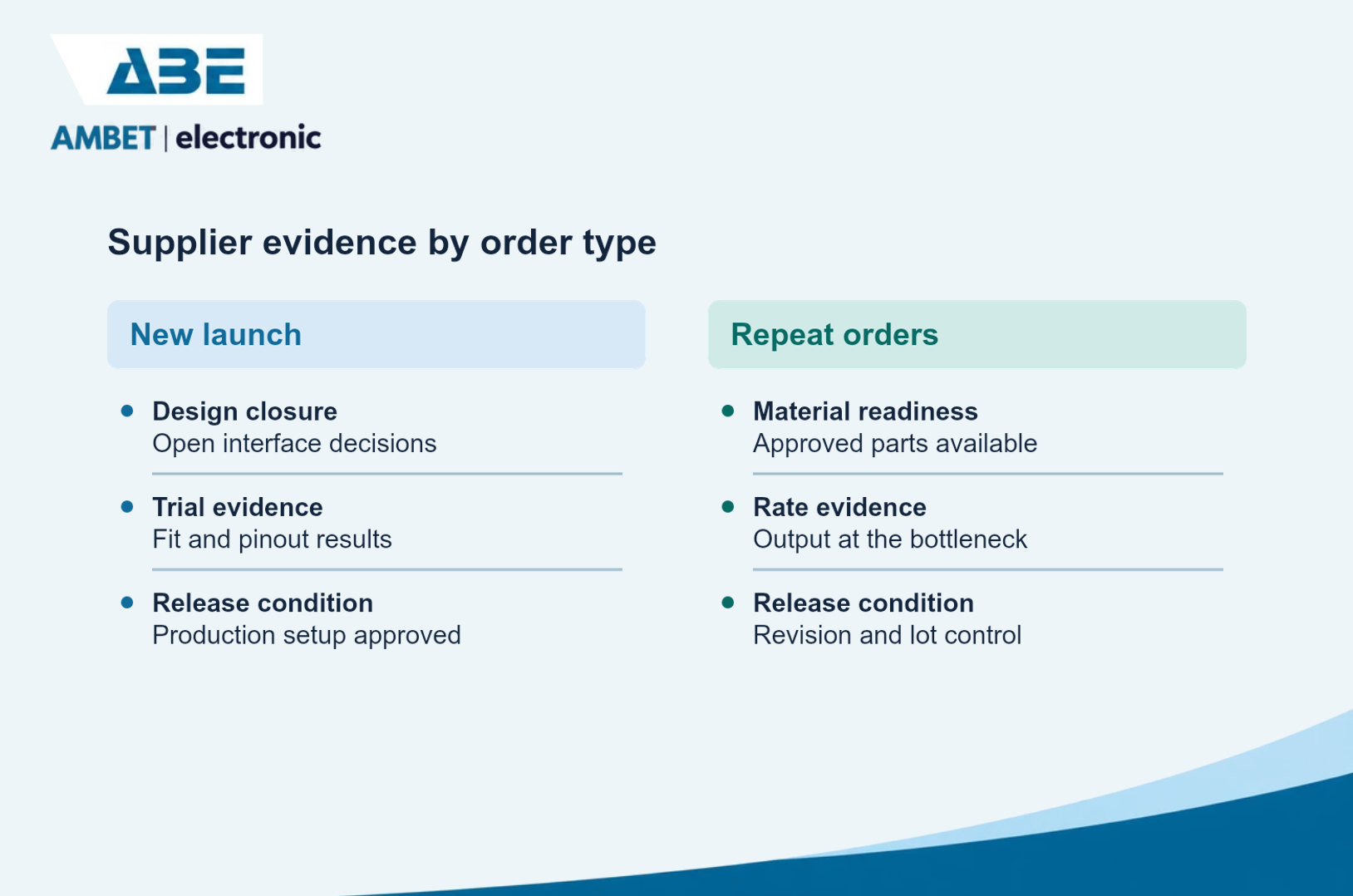
The qualities that matter most during prototype development are not always the same as those needed for a stable replenishment program. A supplier should understand the difference between the two.
During a new launch, good suppliers clarify technical questions, coordinate samples, and plan production readiness. For repeat orders, they maintain approved configurations, monitor component availability, demonstrate relevant capacity, and communicate changes before they disrupt delivery or product quality.
Why Does Engineering Support Matter During a New Project?
A new custom harness can go through several revisions before the customer approves the final design. The first sample may reveal that a connector is difficult to reach, a branch interferes with a bracket, or a clip cannot be fitted in the intended installation sequence.
A good supplier does not merely rebuild the sample each time a new instruction arrives. It reviews the effect of the change on the components, tooling, dimensions, and test requirements. It should also explain whether the proposed change creates new cost or schedule implications.
For example, changing to a right-angle connector may resolve an installation clearance issue but affect the required terminal or wire exit. Reviewing those dependencies before sampling can prevent a second unnecessary revision.
A well-managed prototype project distinguishes the responsibilities of both sides. The manufacturer reviews buildability and produces the agreed sample. The customer's design team confirms the intended system function and approves the technical requirements. Both parties agree on the evidence needed before production proceeds.
What Makes a Supplier Reliable for Repeat Orders?
For a distributor, the replacement harness received six months later needs to match the approved SKU. For an OEM, the next production batch needs to fit the same equipment and satisfy the same technical requirements unless a change has been authorized.
Consistency depends on more than retaining an old sample. The supplier must have access to the correct drawing, BOM, pinout, tooling, instructions, and inspection criteria for each build.
It also needs to manage material availability. A discontinued terminal, delayed connector, or unexpected increase in demand can affect future orders even if the current batch is completed successfully.
A reliable supplier communicates those issues before the customer depends on the delivery. If an alternative component is proposed, the supplier explains the difference, provides the relevant technical evidence, and obtains approval where required. It does not introduce an unapproved substitute simply to maintain the original shipment date.
| Buying situation | Useful supplier evidence | Warning sign |
|---|---|---|
| New industrial-machine harness | Open technical questions, sample milestones, and a fit and pinout review plan | The supplier cannot explain what remains unconfirmed |
| Transfer of an established aftermarket SKU | Approved specification, tooling plan, and revision identification | Old and new configurations can be mixed during packing |
| Monthly replenishment | Material planning, controlled build records, and an agreed delivery schedule | Availability is assumed without checking critical components |
| Recurring demand with a peak month | Capacity evidence at the limiting operation and a plan for critical materials | Output is based on total headcount rather than the relevant process |
| Multiple similar SKUs | Separate part identification, instructions, testing, and packing controls | Similar products share labels without a reliable distinction |
How Can You Tell Whether a Supplier Has Enough Production Capacity?
Factory size can be useful background information, but it does not establish the available capacity for a particular harness.
A production line may have several wire processing machines but only one test fixture for a specific connector configuration. The limiting operation could also be terminal insertion, branch assembly, special inspection, or another process that needs particular tooling.
For an illustrative example, assume a final test station can verify 100 harnesses per hour under the intended setup. If it has six effective testing hours available per day for the order, its theoretical test capacity is 600 assemblies per day. That is not yet a confirmed shipment rate: rejects, retesting, material shortages, upstream assembly, and other constraints must also be considered.
Cummins Meritor's supplier quality requirements2 illustrate how capacity studies and run-at-rate reviews can form part of an automotive supplier assessment. The appropriate level of evidence depends on the project.
For a recurring OEM order, a useful capacity discussion covers the exact part number, expected order frequency, peak demand, shared equipment, and time required for changeovers. For an aftermarket distributor with many smaller SKUs, the ability to restore a previously approved setup may matter more than the maximum output of a dedicated high-volume line.
How Do Good Suppliers Communicate When Something Changes?
Unexpected problems are not always avoidable. The quality of a supplier relationship becomes particularly visible when one occurs.
| Situation | A proactive supplier | A potential warning sign |
|---|---|---|
| Connector shortage | Identifies affected parts, explains available options, and updates the schedule | Waits until the promised shipping date to report the shortage |
| Drawing change | Confirms the revision, affected materials, and approval steps | Starts building from an informal message without resolving conflicts |
| Failed inspection | Holds potentially affected products and investigates the cause | Replaces the failed sample without examining the rest of the lot |
| Urgent additional demand | Checks material and available capacity before committing | Promises immediate delivery without a feasible production plan |
A useful update should state what has happened, which products or orders are affected, who is coordinating the response, and when the next information will be available. It should distinguish a confirmed fact from a forecast.
This is particularly valuable when the buyer and supplier work across different time zones. Clear, consolidated communication can prevent repeated misunderstandings and help the customer's purchasing and engineering teams make decisions using the same information.
What Evidence Should You Review Before Releasing the Order?
An acceptable prototype and a successful production batch provide different types of evidence. A good supplier understands both and can explain what remains to be checked before volume production.
Before releasing production, review the approved specification, production-intent sample, relevant quality records, material availability, and capacity plan. Agree how deviations, engineering changes, failed inspections, and affected shipment lots will be controlled throughout the supply relationship.
What Does Consistent Quality Control Look Like?
Quality should be built into the process rather than checked only after the entire harness is assembled. The necessary inspections depend on the product, but a controlled process generally identifies the important characteristics and the stages at which they can be verified.
| Manufacturing stage | What a good supplier should be able to explain |
|---|---|
| Incoming materials | How approved wires, housings, terminals, and other parts are identified |
| Wire preparation | How cutting, stripping, and conductor condition are checked |
| Crimping | How approved tooling, setup, and required crimp measurements are controlled |
| Harness assembly | How pinout, terminal seating, routing, clips, and protection are verified |
| Final testing | Which circuits and characteristics are checked and against which requirements |
| Lot release | How inspection results, exceptions, and shipment identification are reviewed |
Electrical continuity is important, but it does not establish every physical and mechanical property of a wire harness. A correct pinout cannot compensate for an incorrectly positioned mounting clip. Similarly, a visually attractive crimp does not independently demonstrate its mechanical retention.
Ask what checks apply to every finished harness, which are performed on designated samples, and which require separate qualification. The supplier should be able to explain the inspection plan for the specific product rather than rely only on a generic description of its quality system.
Why Is Production Readiness Different From Sample Approval?
A prototype can be assembled using a dedicated engineering setup. Mass production may use different fixtures, workstations, or processing equipment. The customer needs confidence that the intended process can reproduce the approved design.
Where a program requires Production Part Approval Process (PPAP), AIAG describes the process3 in relation to meeting engineering and specification requirements consistently during actual production. PPAP is not automatically required for every commercial or aftermarket harness; confirm the applicable customer requirements and submission scope.
For other projects, an agreed sample approval and production-readiness review may be appropriate. The evidence should connect the relevant materials, manufacturing methods, and inspection results to the approved configuration.
True or False:
Once a wire harness sample passes electrical testing, its supplier is ready to deliver recurring production quantities.
False.
A successful sample confirms the characteristics and conditions that were checked. Production readiness also depends on approved materials, suitable tooling, repeatable work instructions, inspection controls, and the capacity to produce the required quantity.
How Should a Good Supplier Handle Quality Problems After Delivery?
Even a controlled manufacturing process can experience an unexpected problem. A supplier's response matters because a customer may need to protect production stock or address downstream service requirements while an investigation is underway.
A useful quality response starts with the affected part number, revision, lot, defect description, and available evidence. The supplier and customer can then establish what needs to be contained and which checks will support the investigation.
For example, if a customer reports a terminal backing out of a connector, the manufacturer should distinguish terminal retention from a loose conductor crimp or an installation load. Traceability records may help identify related production batches, but a shared lot alone does not prove that every unit has the same defect.
A good supplier should explain the suspected scope, preserve the relevant records and samples, investigate the cause, and verify the corrective action. Any sorting, rework, replacement, or commercial resolution should follow the agreed process. The customer should know what has been confirmed and what remains under investigation.
What Goes in the Purchase Order or Quality Agreement?
A clear agreement gives both parties a reference when questions arise after sampling or delivery. Depending on the complexity of the project, relevant information can be included directly in the purchase order or referenced through controlled technical and quality documents.
- The customer part number, approved drawing revision, BOM, and acceptance criteria.
- Order quantity per part number, pricing, separate charges, and delivery arrangements.
- Required inspection records, traceability identifiers, and retention expectations.
- Approved material alternatives and the process for requesting changes or deviations.
- Packaging, labeling, and handling requirements.
- Responsibilities for sample approval, production release, and customer complaints.
A good working relationship is not built on vague assurances. It develops when the manufacturer can explain its commitments and the customer can provide timely technical and commercial decisions.
If you are developing a custom automotive or industrial wiring harness with AMBET, send us the available drawing, BOM, pinout, or reference sample, along with your expected quantities and installation requirements. These details help us review the manufacturing scope, identify open questions, and prepare a quotation on a clearer basis.
Conclusion
A good wiring harness supplier combines technical competence, controlled production, transparent communication, and reliable follow-up. Look for evidence that these qualities support your specific project and repeat-order requirements.
Shows how one vehicle OEM separates quality system, historical performance and verification practices during pre-award screening. ↩
Gives an automotive industry example of on-site manufacturing process review and associated capacity checks. ↩
Explains how production part approval addresses consistent output at the actual production rate. ↩