ISO 9001 vs IATF 16949: What Buyers Should Know

A supplier can send a valid certificate and still quote from a factory outside its scope. Set the requirement at RFQ stage and verify the proposed build site.
ISO 9001 sets general quality management system requirements. IATF 16949 builds on that foundation for automotive manufacturing. Wire harness buyers should confirm the requirement for their program, verify the actual manufacturing site and scope, and approve the part separately.
Start with what each standard covers. Then match the requirement to the order, the facility, and the evidence your quality team needs before release.
What Do ISO 9001 and IATF 16949 Cover?
Both names appear on supplier profiles. It helps to know what each tells you about the way a harness is made and controlled.
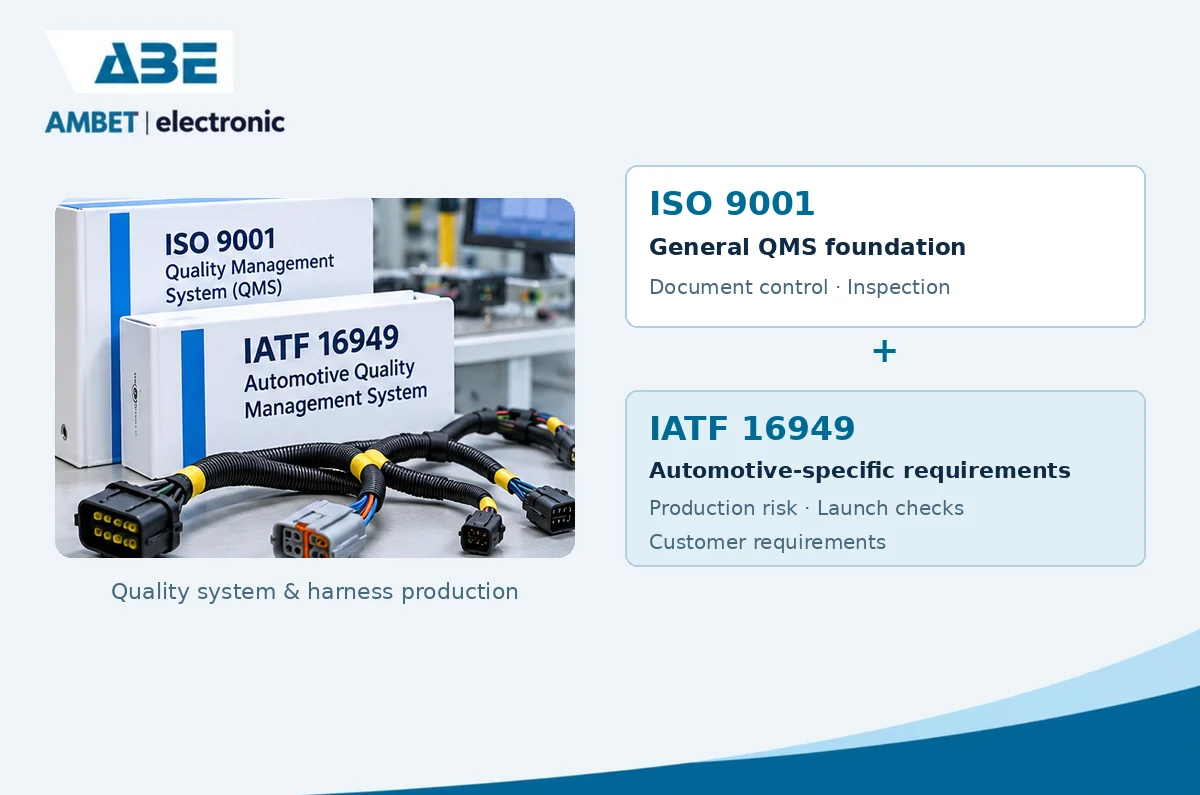
ISO 9001 is a cross-industry quality management system standard. IATF 16949 adds automotive-specific requirements, such as more detailed controls for production risk, launch, and customer requirements. Both address the management system within the certified scope.
What Does an Automotive Quality System Add for Harness Buyers?
For a harness supplier, a general quality system can help structure how orders are reviewed, drawing revisions are controlled, and problems are investigated. One concrete check is to ask how an approved pinout revision reaches the assembly line and the electrical test fixture. A supplier should be able to trace those changes to the revision it built.
Automotive programs often need more detailed evidence of how the line handles risk. Take a connector with cavities that look identical from the wire side. Ask how the supplier identifies the risk of loading the wrong cavity, how it prevents or detects the error, and how it records the response when a unit fails.
| What to compare | ISO 9001 | IATF 16949 |
|---|---|---|
| Scope of the standard | Quality management across industries | Quality management for eligible automotive manufacturing |
| What to discuss with the supplier | Document control, purchasing, inspection, and corrective action | Automotive production controls, launch checks, and applicable customer requirements |
| Evidence for your harness | The revision and controls agreed for the order | Those records plus any program-specific automotive evidence required by the customer |
For a revision change, ask for one example that connects the order, drawing, work instruction, and test record. For a launch, ask how the supplier checks those links at the proposed site before the first lot. The answer gives you something concrete to compare across suppliers with similar certificate claims.
When Should a Wire Harness RFQ Require IATF 16949?
The same type of connector can appear in an OEM assembly, a service harness, and a private-label replacement. The purchasing requirements can differ.
Start with the end use and the customer's written requirements. Specify IATF 16949 when it is required for the sourcing program and proposed manufacturing site. Confirm any permitted alternative or exception in writing before awarding the order.
How Do Requirements Differ for Vehicle Production, Service Parts, and Independent Aftermarket Orders?
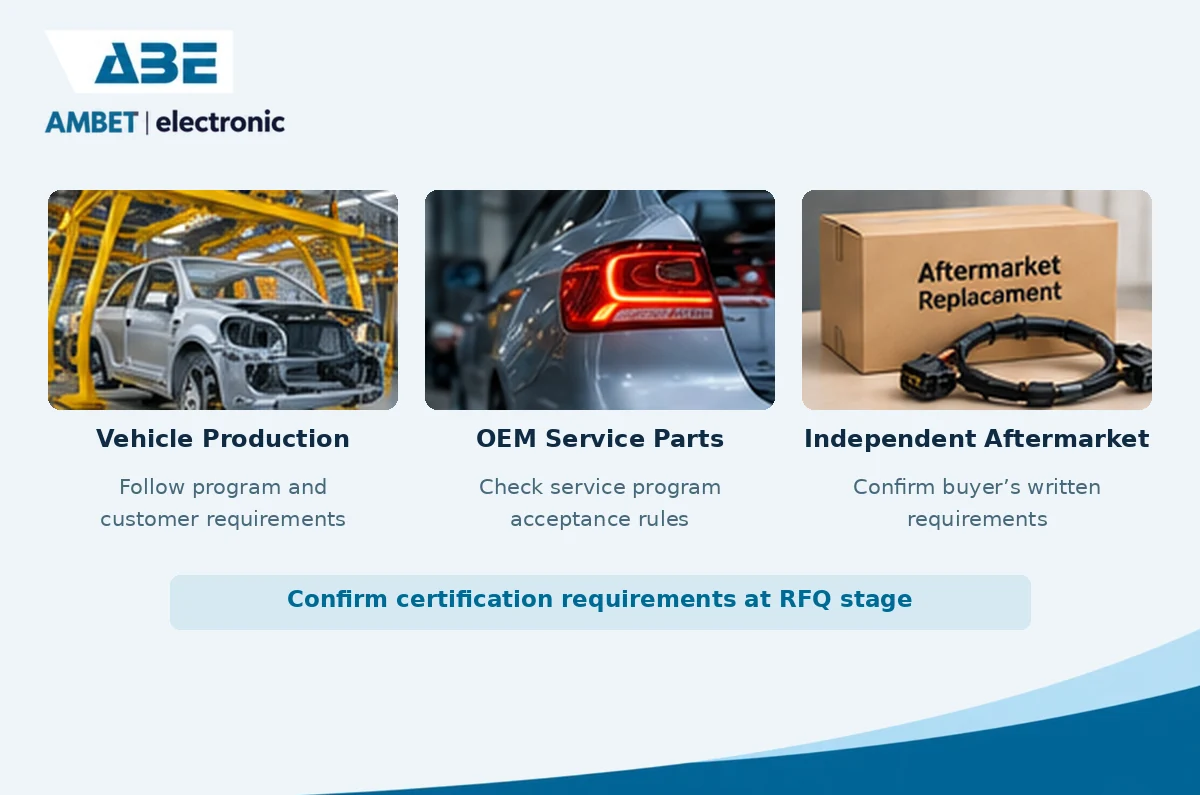
If the harness goes into vehicle production, ask the program owner or direct customer which approved supplier and manufacturing-site conditions apply. A lower-tier supplier should work from the requirements that its direct customer has given it. Confirm whether the purchase documents also incorporate requirements from the end OEM.
For an OEM service part, check the service program's own acceptance and change-control rules. Reusing a drawing from a production part gives engineering a reference, while purchasing still needs to check the service part's sourcing and approval obligations.
For an independent replacement, a manufacturing site may be eligible for IATF 16949 certification if its activity falls within the IATF rules for replacement parts1. Eligibility and the buyer's purchasing requirements are separate decisions.
Determine the certificate, fitment evidence, and tests your private-label or distribution program requires. For example, where the agreed program accepts an ISO 9001 site, a buyer can still require connector fit, cavity mapping, and a repeatable electrical test record for each harness family.
Which Customer-Specific Requirements Should You Check Before Sourcing?
Ask for the documents that apply to the specific customer, manufacturing site, and part. These may include a supplier quality manual, a customer-specific requirement document, and a separate part approval requirement. Capture the document versions in the RFQ so suppliers respond to the same criteria.
State which certificate is required at quotation, award, or launch, as applicable. If a supplier proposes a different route, obtain a decision from the customer or quality owner responsible for approving it. This prevents a quotation assumption from becoming a sourcing commitment.
How Should Buyers Read Certificates During the ISO 9001 Transition?
A supplier file can contain an ISO 9001:2015 certificate after publication of the 2026 edition. The revision printed on the certificate is one part of the check.
Check the edition, certificate status, applicable transition rules, and your customer's acceptance date. ISO 9001:2026 is the current edition, and existing accredited ISO 9001:2015 certifications have a transition period. Follow separate IATF updates for automotive certification.
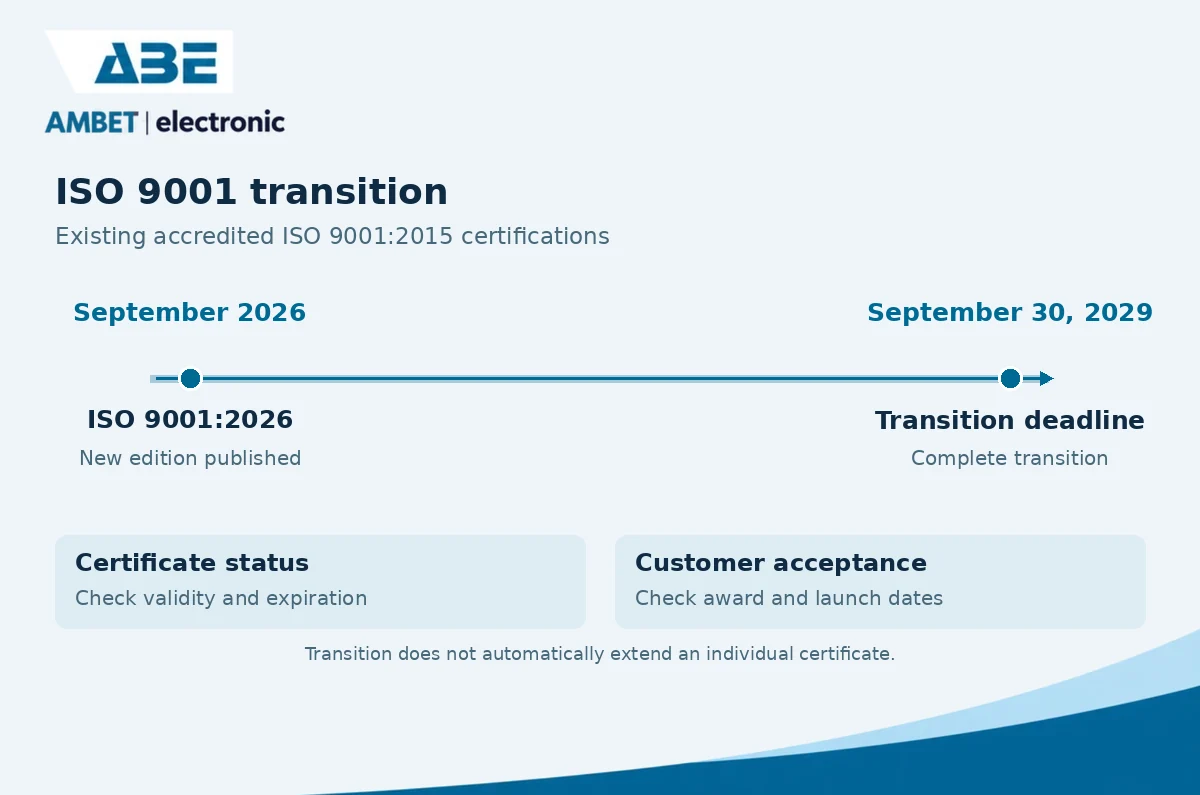 ISO published the 2026 edition in September 2026. Its technical committee's transition guidance2 gives organizations already certified to ISO 9001:2015 until September 30, 2029 to complete their transition.
Use that as the general transition deadline. Check the individual certificate's status, expiration, and the issuing body's plan, since the transition deadline does not extend an individual certificate on its own.
Suppose a supplier offers a valid ISO 9001:2015 certificate for a new harness launch. Record the planned launch date and check what the customer's sourcing rules accept at that point.
Ask the supplier's quality team when the transition audit and certificate issue are planned. If the applicable requirement changes before the production award, agree how the supplier will provide updated evidence and who will review it.
Check three items when reviewing dates:
- The current status and expiration of the certificate for the site in the quote.
- The transition timing set by the applicable accreditation and certification arrangements.
- The edition and date your customer requires at each sourcing milestone.
Manage IATF timing separately. IATF 16949:2016 was written as a supplement to ISO 9001:20153, and IATF has published a separate revision update with planning dates subject to change. Check the latest IATF guidance and the program's written requirements when scheduling automotive qualification.
How Do You Verify That the Certificate Covers the Manufacturing Site?
Sales, assembly, and testing can be done at different addresses. The buyer needs to identify the location that will manufacture the harness.
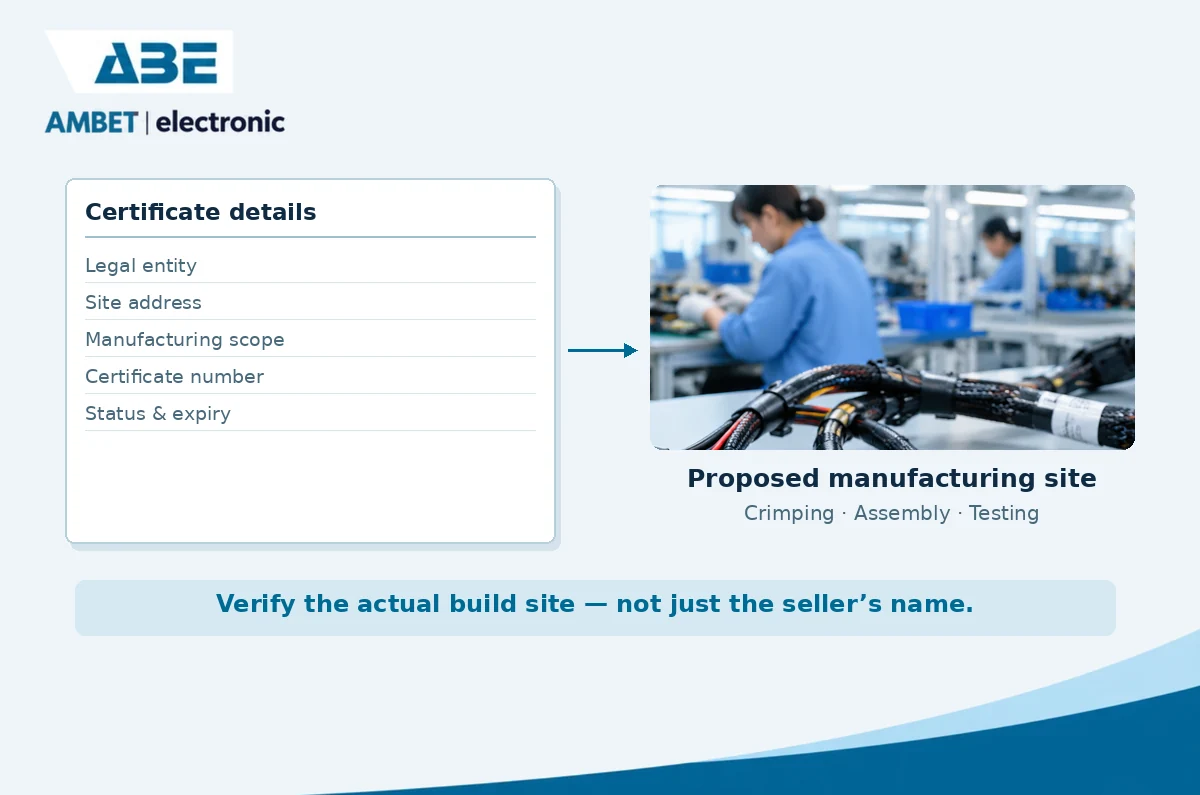
Match the certificate's legal entity, site address, scope, status, and certificate number to the manufacturing location in the quote. Use the issuer's verification route for ISO 9001 and the IATF certificate validity check for IATF 16949.
What If the Seller and Manufacturing Site Are Different?
First obtain the complete certificate and any scope or location annexes. Record the entity and address from the offer, then ask which location will perform terminal crimping, assembly, and final testing. Where work is split, ask the supplier to identify the relevant sites and provide the evidence required for each activity under the sourcing program.
For IATF 16949, use the IATF number or unique site identifier4 to look up the certificate. Compare the returned site and status with the document.
Read the scope in the certificate and annexes for the relevant manufacturing activity. If a group has multiple addresses, ask for documentation that covers the proposed build site.
True or False:
A current certificate for one factory in a group shows that a different factory in the group is covered.
False.
Check the certificate and its supporting documents for the actual manufacturing location. A shared owner or seller name gives you a starting point for verification, while the site and scope establish what is covered.
For example, a seller submits an IATF certificate for Plant A but plans to move the order to Plant B after sample approval. Check Plant B before accepting the revised sourcing plan.
If the evidence is missing, keep the applicable qualification item open and ask the quality owner to decide whether the move can proceed. Tie any approved change to the part number, location, and affected production date.
What Evidence Should Buyers Request Before Approving a Harness for Production?
The system certificate tells you about the facility's quality management. A production decision also needs results for the harness on your drawing.
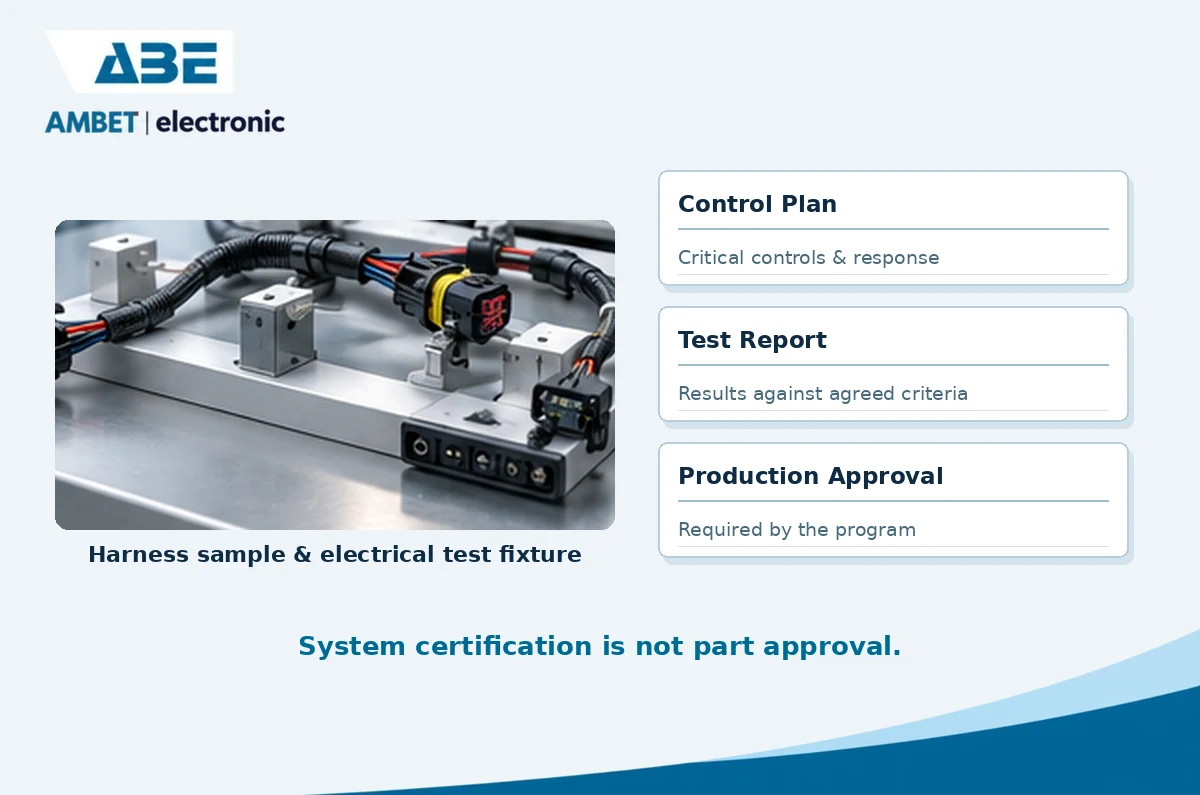
Agree on the approval package before the pilot run. Request a controlled drawing revision, a sample from the proposed process, and evidence for critical controls and tests. Require PPAP or another approval package when the program specifies it.
Which Records Show That the Actual Part and Process Meet Your Requirements?
Start with the approved drawing, bill of materials, and circuit map. Identify the characteristics the buyer needs to see verified.
For a multi-branch harness these can include connector orientation, branch length, terminal fit, and the circuit-to-cavity mapping. Specify which checks must accompany production and what the supplier should retain.
Ask how the process plan links each important risk to a control and a record. If a crimp characteristic is critical, agree the applicable measurement, sampling or testing requirement, and response when the result fails. Agree similar details for the electrical test so a shared pass status does not hide which revision or circuit map was used.
When PPAP is required, confirm the submission level, supporting evidence, and the customer's approval route before the supplier runs samples. Part approval5 evaluates the design record and the production process used to make the part.
A sample made with a temporary fixture may help check fit early. Production approval should reflect the intended manufacturing process and what the customer agreed to review.
For repeat orders, keep the approval records by part number, revision, and site. Set out which changes require notice or renewed approval, such as moving the build, changing a terminal, or switching a test fixture. If a certificate is renewed, check its scope and dates while retaining the existing part-level evidence for the approved configuration.
Conclusion
Match the standard to your program, verify the build site's coverage, and approve the harness against its actual specification and production process.
Explains IATF eligibility for certain aftermarket replacement parts and how replacement activity appears in the certificate scope. ↩
Sets out ISO 9001:2026 publication and the transition timetable for existing accredited ISO 9001:2015 certification. ↩
Explains the relationship between the IATF 16949:2016 automotive requirements and ISO 9001:2015 when the automotive edition was introduced. ↩
Shows how buyers can use an IATF number or unique site identifier to check the site and certificate status. ↩
Explains how PPAP relates engineering requirements to evidence from the production process. ↩