What Is an Automotive Pigtail Connector? A Buyer’s Guide

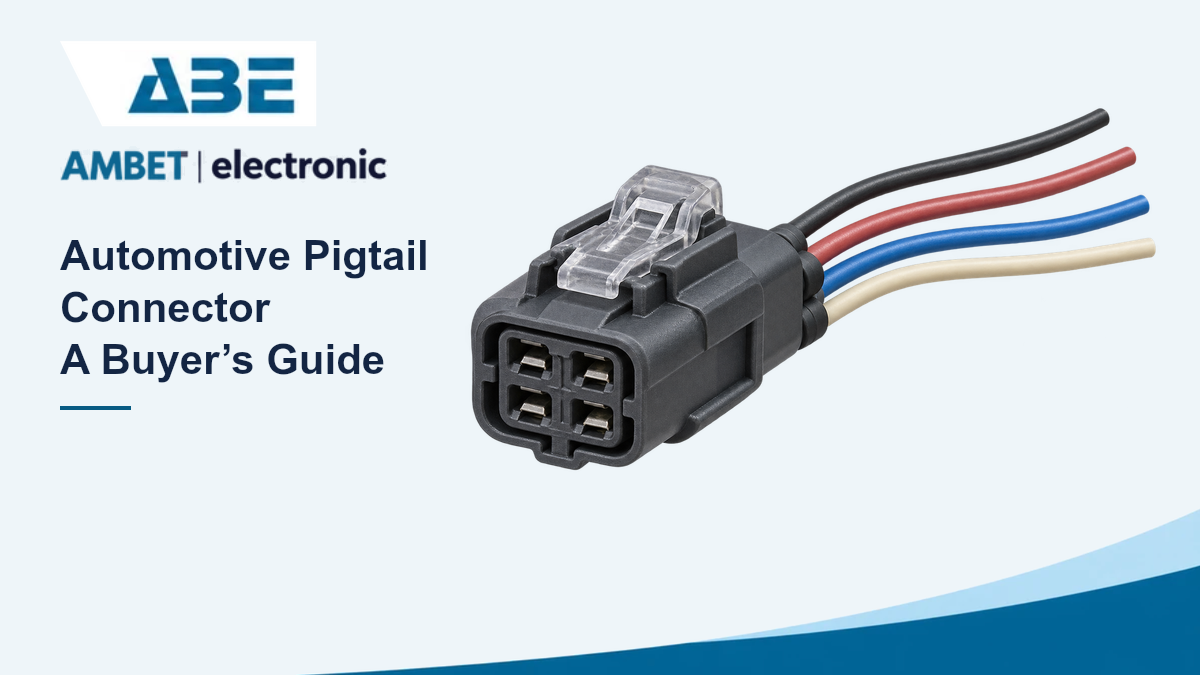
An automotive pigtail connector is a small component, but choosing the wrong one can lead to installation problems, electrical failures, and unnecessary product returns.
An automotive pigtail connector is an electrical connector with short, preterminated wires. It connects vehicle components to a wiring harness and is commonly used in automotive electrical connections, replacement parts, and wiring harness repairs.
I recommend looking beyond the connector's appearance when sourcing pigtails. Two connectors may look almost identical but have different terminals, pin configurations, or wire specifications. These small differences matter, especially when you are purchasing in bulk.
What Is an Automotive Pigtail Connector, and What Does It Replace?
A damaged connector does not always mean the entire vehicle wiring harness needs to be replaced. In some applications, a pigtail connector offers a more practical solution.
An automotive pigtail connector consists of a connector housing, electrical terminals, and short attached wires. It provides an electrical interface between vehicle components and wiring circuits and can support local repairs where the vehicle manufacturer permits them.
What Are the Main Components of an Automotive Pigtail Connector?
A typical automotive pigtail connector contains several parts that work together to provide a reliable electrical connection.
| Component | Main Function |
|---|---|
| Connector housing | Holds and protects the terminals |
| Metal terminals | Provide electrical contact with the mating component |
| Wire leads | Carry electrical power or signals |
| Locking features | Help prevent accidental disconnection |
| Wire seals, where required | Help protect the wire-entry area from moisture |
| Secondary terminal lock, where fitted | Helps keep terminals securely positioned |
The number of wires depends on the electrical function of the connector.
For example, a simple lighting connector may have two wires, while a sensor connector may have three or more wires for power, ground, and signal connections.
Some pigtails use sealed connector housings. Others use unsealed connectors for more protected installation areas.
I would not judge the quality of a pigtail only by its housing. The terminal material, crimp connection, wire specification, and sealing structure are equally important.
Where Are Automotive Pigtail Connectors Commonly Used?
Automotive pigtail connectors are used in many vehicle electrical systems.
They are particularly relevant to the automotive aftermarket because individual connectors or local wire sections may become damaged during vehicle operation.
Common applications include:
| Application | Typical Connection |
|---|---|
| Headlight pigtail connectors | Headlight and bulb connections |
| Tail light pigtail connectors | Rear lighting assemblies |
| Fog light pigtail connectors | Auxiliary and fog lighting circuits |
| Fuel injector connectors | Fuel injector electrical connections |
| Ignition coil connectors | Ignition system connections |
| Engine sensor connectors | Temperature, pressure, and other sensors |
| Cooling fan connectors | Cooling fan motors and related circuits |
| Trailer lighting connectors | Trailer lighting and electrical connections |
These applications have different electrical and environmental requirements.
For example, a cooling fan connector may need to carry more current than a small sensor connector.
A connector installed near an engine may also need greater resistance to heat and vibration than one installed inside the vehicle cabin.
For aftermarket distributors, I recommend organizing pigtail products by verified application, connector type, and OE reference rather than pin count alone.
This makes it easier to manage product listings and reduce the risk of selling an incompatible replacement part.
What Is the Difference Between a Pigtail Connector and a Complete Wiring Harness?
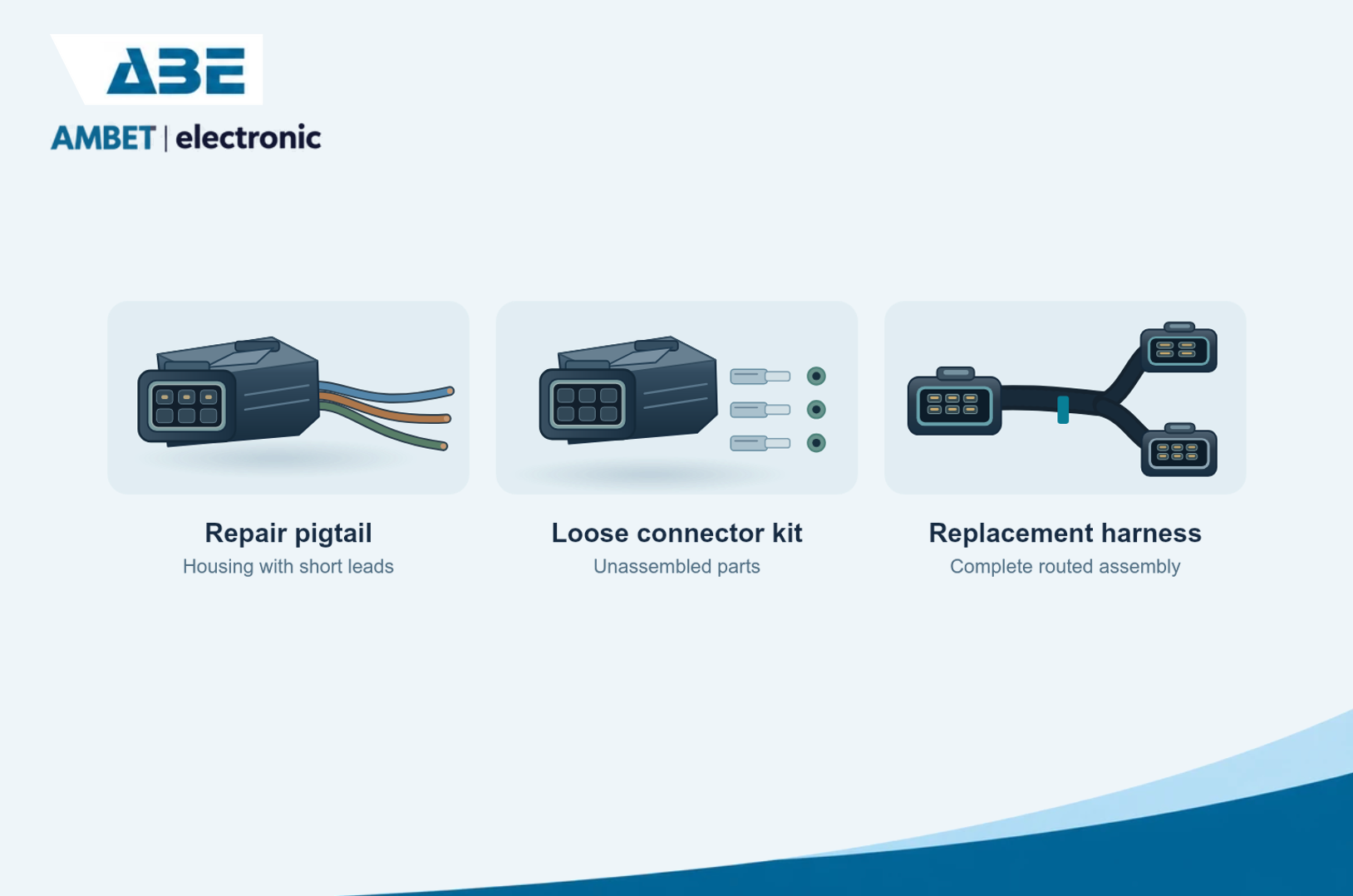
Buyers sometimes use the terms connector, pigtail, and wiring harness interchangeably. However, these products cover different assembly and repair requirements.
| Product | Typical Contents | Main Purpose |
|---|---|---|
| Loose connector kit | Housing, terminals, and seals where included | Building or repairing a connector |
| Pigtail connector | Connector with preterminated wire leads | Connecting or locally replacing an electrical interface |
| Complete wiring harness | Wires, connectors, branches, and protective materials | Connecting multiple components within an electrical system |
A loose connector kit may require the installer to select wires, crimp terminals, and assemble the connector.
A pigtail already has its terminals and short wire leads assembled.
A complete wiring harness generally covers a larger part of the electrical system and may include several branches and connectors.
For a distributor, these differences also affect product descriptions, packaging, and pricing.
I recommend confirming the exact contents of each product before creating a catalog listing.
Some pigtail kits may include separately supplied repair materials1, while others contain only the assembled connector and wire leads.
When Is a Pigtail the Right Service Part?
Consider a vehicle headlight connector with a damaged housing and heat damage around the wire entry.
If the vehicle manufacturer permits a local repair and the remaining harness is in suitable condition, a replacement pigtail may be an appropriate solution.
However, not every damaged connector can be repaired in this way.
Damage extending farther into the harness may require a larger replacement assembly. Certain safety-related, high-voltage, or specialized circuits may also have specific repair restrictions.
I recommend checking the applicable vehicle manufacturer's wiring repair procedure2 before assigning a repair application to a replacement pigtail.
True or False:
A damaged automotive connector always requires replacement of the complete wiring harness.
False.
A replacement pigtail may be suitable when the damage is limited to the connector and nearby wires, provided the vehicle manufacturer permits the repair and the remaining harness is serviceable.
How Do You Match a Pigtail to the Vehicle?
Two pigtail connectors may have the same shape and number of wires but serve different electrical functions. Appearance alone is not enough to confirm compatibility.
To match an automotive pigtail connector to a vehicle, verify the OE part reference, vehicle application, connector dimensions, pinout, terminal specifications, wire gauge, lead length, and environmental protection requirements.
How Do You Identify the Correct Vehicle Application?
I would start with the original connector reference and vehicle application.
For automotive aftermarket products, the vehicle make and model alone may not provide enough information.
Different model years, engine options, equipment packages, or production configurations may use different electrical connectors.
For example, two versions of the same vehicle may use different headlight assemblies.
Although both connectors serve a lighting function, their housing designs, terminal positions, and electrical requirements may be different.
I recommend confirming the following information:
- OE part number or service reference
- Vehicle make and model
- Applicable model years
- Engine or equipment configuration
- Installation location
- Mating component
- Documented replacement part references, where available
For distributors managing large product catalogs, a structured fitment data standard3, such as ACES, can help communicate verified vehicle compatibility information to trading partners.
However, a catalog reference is not a substitute for actual product verification.
What Do the Connector Face and Wire-Entry Views Tell You?
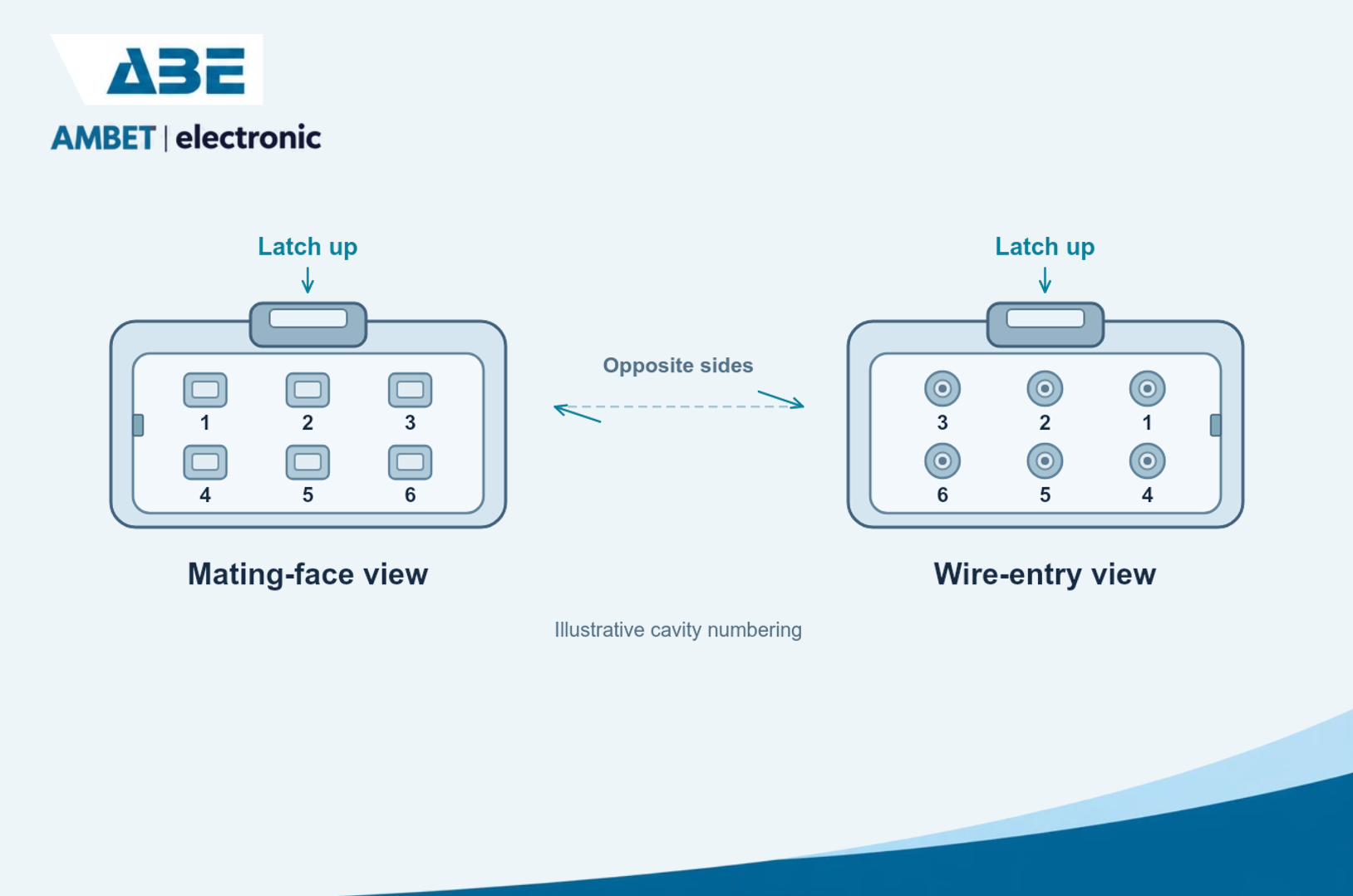
The connector face provides important information about its physical compatibility.
I recommend checking the housing shape, latch position, keying features, terminal arrangement, and cavity numbering.
The viewing direction also matters.
A connector viewed from its mating face may show a different apparent pin arrangement from the same connector viewed from its wire-entry side.
If the drawing does not clearly identify the viewing direction, the manufacturer may install wires in incorrect positions.
For example, consider two connectors that both have six cavities and four attached wires.
| Connector | Occupied Cavities | Number of Wires |
|---|---|---|
| Connector A | 1, 2, 3, 4 | 4 |
| Connector B | 1, 2, 5, 6 | 4 |
These are hypothetical examples.
Both connectors may look similar in a product photograph. However, their internal wiring arrangements are different.
They should not be treated as interchangeable without checking the actual circuit requirements.
I would always compare the numbered cavities and approved pinout before confirming a replacement product.
True or False:
Matching the wire colors is enough to identify the electrical connections of an automotive pigtail connector.
False.
Wire colors can help identify connections, but they are not universal across different manufacturers and replacement parts. The approved pinout, cavity numbering, and circuit functions should determine the correct wiring arrangement.
Which Lead Details Belong in the Specification?
The short wires attached to a pigtail connector are just as important as the connector itself.
Their specifications affect electrical performance, crimp compatibility, and installation.
For example, a connector used for a cooling fan may require a different wire gauge from one used for a temperature sensor.
I recommend checking the following specifications:
| Wire Specification | Why It Matters |
|---|---|
| Wire gauge | Affects current capacity and terminal compatibility |
| Conductor construction | Influences flexibility and crimp quality |
| Insulation material | Determines suitability for operating conditions |
| Wire length | Affects installation and available repair length |
| Wire color | Helps identify individual circuits |
| Wire-end condition | Determines how the pigtail connects to the existing harness |
| Insulation diameter | Affects compatibility with terminals and wire seals |
The terminal must match the selected wire size.
For sealed connectors, the outer diameter of the wire insulation also needs to match the sealing system.
Connector manufacturers may specify different conductor and insulation diameter ranges4 for different terminals and seals.
A pigtail may connect correctly at the mating face but still have unsuitable wire specifications.
This is why I recommend checking both sides of the assembly.
Should You Choose a Sealed or Unsealed Pigtail Connector?
The answer depends on the installation environment.
A sealed automotive connector is designed to help protect the electrical interface against moisture and contaminants under specified conditions.
An unsealed connector may be suitable for a more protected installation area when the application permits it.
| Connector Type | Typical Application | Key Consideration |
|---|---|---|
| Sealed connector | Engine compartments and exposed vehicle areas | Interface seals and wire-entry protection |
| Unsealed connector | Protected interior electrical connections | Application suitability |
| High-temperature connector | Areas exposed to elevated temperatures | Housing, terminal, and insulation ratings |
I would not select a sealed connector simply because it appears more durable.
The connector must match the mating component, electrical requirements, and installation conditions.
If the connector has unused cavities, the approved sealing design may also require suitable cavity plugs.
The environmental protection of the finished assembly depends on the complete connector system, not just the housing.
What Should Buyers Approve Before Placing a Bulk Order?
A pigtail may fit the intended component during sample testing, but incorrect materials, inconsistent assembly, or inaccurate product labels can still create problems during bulk purchasing.
Before placing a bulk order, buyers should approve the connector type, pinout, wire specifications, lead dimensions, sealing components, electrical test results, vehicle fitment information, and packaging requirements.
What Goes in an RFQ for Each Part Number?
When requesting a quotation for automotive pigtail connectors, I recommend providing more than product photographs.
A photograph can help identify the general connector type, but it may not show the exact terminal design, pin configuration, or wire specifications.
For an accurate quotation, the manufacturer needs enough information to understand the intended assembly.
| RFQ Information | Details to Provide |
|---|---|
| Product reference | Your SKU or OE part number |
| Vehicle application | Make, model, year, and relevant configuration |
| Connector housing | Manufacturer and part number, if known |
| Terminal | Terminal reference and compatible wire range |
| Pinout | Numbered cavities and circuit assignments |
| Wire specifications | Gauge, insulation, color, and length |
| Sealing requirements | Wire seals, interface seals, and cavity plugs |
| Quantity | Sample and production quantities per SKU |
| Packaging | Labels, barcodes, accessories, and packing method |
| Testing | Required electrical and mechanical inspection |
If you have several pigtail models, I recommend preparing a product list with one row for each part number.
For example:
| SKU | Product Description | Order Quantity |
|---|---|---|
| A001 | 2-pin headlight pigtail | 1,000 |
| A002 | 3-pin sensor pigtail | 500 |
| A003 | 4-pin ignition coil pigtail | 500 |
These are illustrative examples, not actual AMBET products or quotations.
The manufacturer can use this information to review component availability, material costs, and production requirements.
At AMBET, buyers can submit an engineering drawing or a labeled reference sample together with their expected order quantities.
If you are developing a new product or modifying an existing pigtail, I recommend identifying the required changes before sample production.
What Should the First Sample and Retail Pack Prove?
Before approving a bulk order, I recommend checking the physical sample against the original connector and approved specifications.
The inspection should cover both electrical and mechanical requirements.
| Inspection Item | What Buyers Should Verify |
|---|---|
| Connector housing | Correct shape, dimensions, and keying |
| Terminal position | Correct cavity assignment |
| Mating compatibility | Correct fit and latch engagement |
| Wire gauge | Matches the approved specification |
| Wire length | Meets the agreed dimensions |
| Crimp quality | Meets the specified inspection requirements |
| Electrical testing | Correct continuity and circuit connections |
| Sealing | Correct seals and cavity plugs, where required |
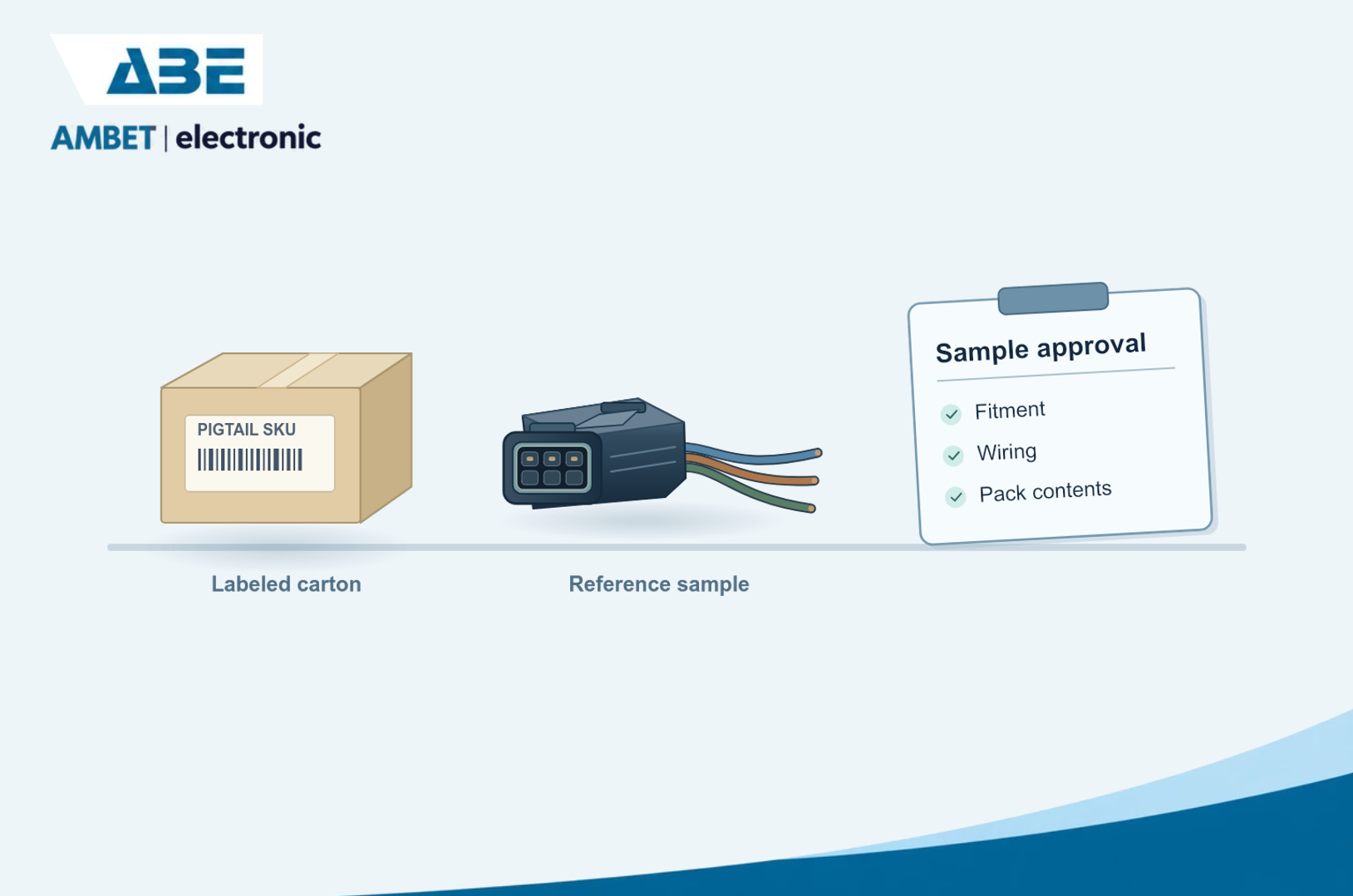
For automotive aftermarket buyers, sample approval should also include the product packaging when retail-ready supply is required.
The barcode, part number, product description, included accessories, and vehicle fitment information should all match the approved product.
For example, two visually similar pigtails may be manufactured correctly but packed under each other's product numbers.
The electrical quality of both products may be acceptable, but the customer still receives the wrong part.
I would therefore treat product identification as part of quality control, especially when purchasing multiple pigtail models.
How Can Buyers Maintain Consistent Quality Across Repeat Orders?
An approved sample is a useful reference for future production. However, buyers should also understand how the manufacturer controls materials and assembly during repeat orders.
For example, a supplier may need to purchase new connector housings or terminals when the original components are no longer available.
A proposed replacement may look similar but have different mechanical or electrical properties.
I recommend agreeing on a change control procedure before mass production.
Buyers should ask:
- Will the manufacturer follow the approved drawing and bill of materials?
- How are connector and terminal part numbers verified?
- How does the manufacturer check pinout accuracy?
- Can production batches be identified and traced?
- Will the manufacturer request approval before changing components?
- How are similar-looking products separated during packaging?
These questions are particularly important for importers, wholesalers, and private-label brands managing several automotive pigtail connector models.
True or False:
Once a pigtail sample has been approved, there is no need to verify subsequent production batches.
False.
Sample approval confirms that the evaluated assembly meets the agreed requirements. Repeat production still requires suitable material control, assembly inspection, electrical testing, and product identification.
Conclusion
I recommend sourcing automotive pigtail connectors based on verified vehicle fitment, connector compatibility, wire specifications, and consistent manufacturing quality rather than appearance or price alone.
Shows an OEM example of pigtail kits and associated repair materials. ↩
Explains vehicle-specific wiring repair requirements and restrictions. ↩
Explains how aftermarket companies exchange structured vehicle fitment data. ↩
Shows how connector specifications define compatible wire sizes, seals, and cavity plugs. ↩