Why Is Wire Harness Assembly Still Manual?

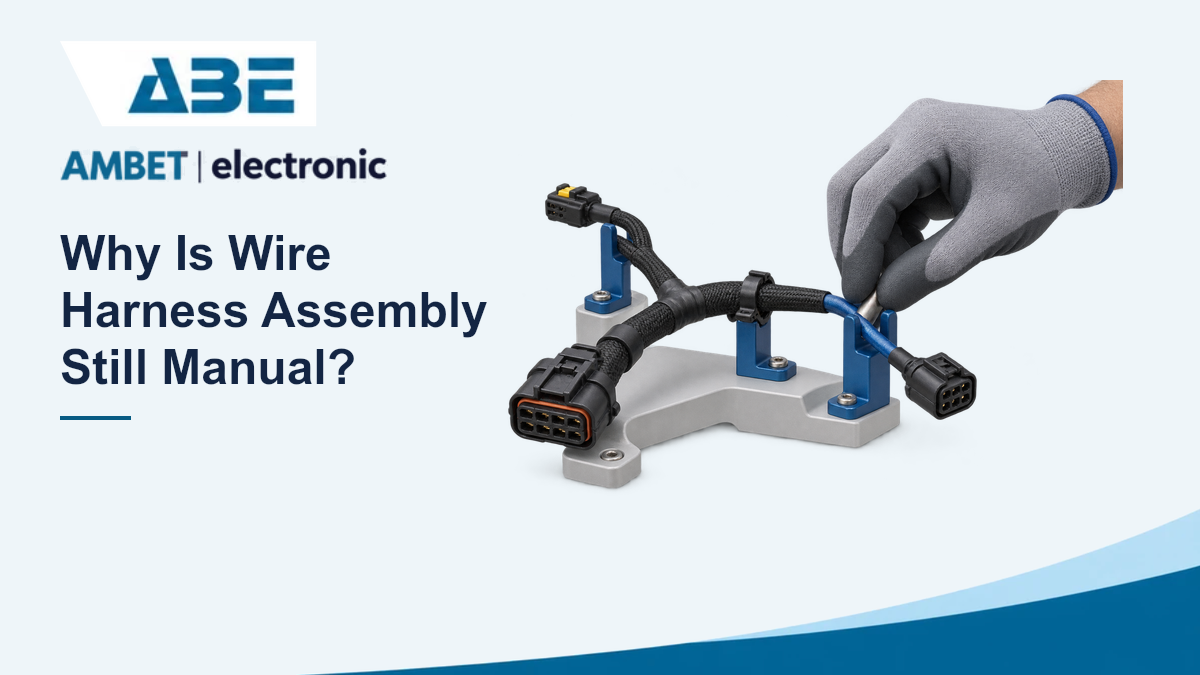
Modern machines can cut and crimp wires quickly. Yet many wire harnesses still require skilled operators to assemble them. Why is full automation so difficult?
Wire harness assembly still relies on manual work because flexible wires, complex branch layouts, different connector designs, and frequent product changes make full automation difficult. Manufacturers often combine automated wire processing with controlled manual assembly and electrical testing.
From a manufacturer’s perspective, the important question is not how much of the line is automated, but whether its production methods match your design, order volume, and quality requirements.
Which Wire Harness Production Steps Can Be Automated?
When buyers visit a wire harness factory, they may see automatic wire processing machines beside operators assembling harnesses by hand. Why are both necessary?
Wire cutting, stripping, seal insertion, crimping, and electrical testing can often be automated. Terminal insertion, branch routing, taping, and accessory installation may require manual or guided operations, depending on the harness design and available equipment.
How Does Automated Wire Preparation Differ from Final Assembly?
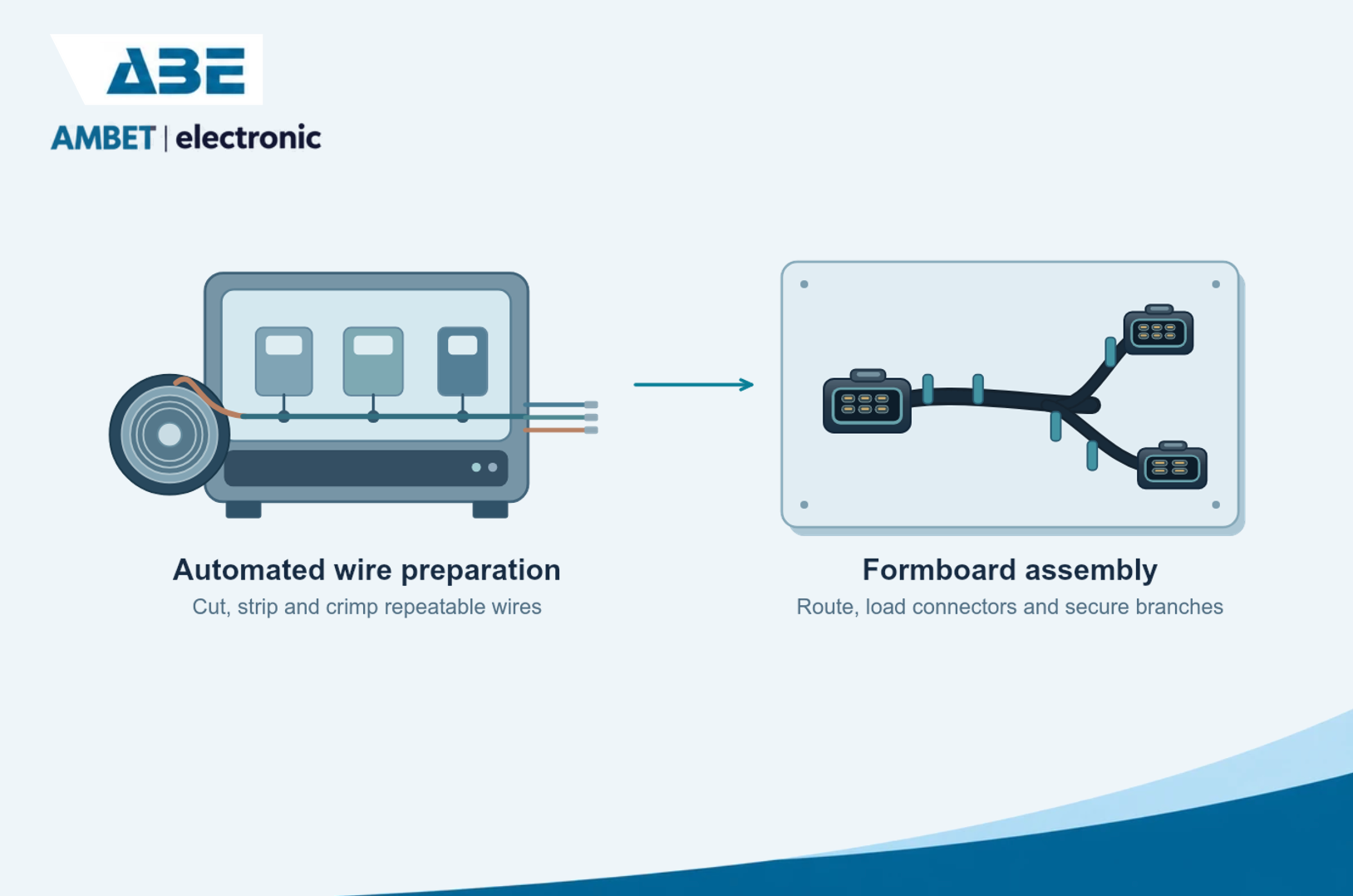
Wire harness manufacturing includes two broad groups of operations: preparing individual wires and combining them into a finished assembly.
The first group is often easier to automate because the equipment can control the position and movement of a wire before it becomes part of a larger bundle.
For example, an automatic wire processing machine can perform cutting, stripping, and crimping1 for supported wire and terminal combinations. Suitable modules can also install seals before crimping.
The machine uses settings that match the specified wire, terminal, and tooling. Once the setup is approved, it can repeat the operation across a batch.
Final assembly is different. The manufacturer must combine wires of different lengths, route branches, insert terminals into the correct connector cavities, and install protective materials and mounting accessories.
The order of these operations matters. For instance, an operator may need to slide a one-piece grommet over a group of wires before installing a connector housing that is too large to pass through it. Cutting all the wires accurately does not solve this assembly problem.
Which Manufacturing Operations Still Require Manual Work?
The production method varies between factories and products. The following table shows common approaches rather than fixed rules for the industry.
| Production step | Common production method | Main consideration |
|---|---|---|
| Wire cutting and stripping | Automatic or semi-automatic | Wire construction, length, and stripping accuracy |
| Seal insertion and terminal crimping | Automatic or semi-automatic | Compatible components, tooling, and setup |
| Wire splicing | Machine-assisted or manual preparation with suitable joining equipment | Approved joining method and wire grouping |
| Terminal insertion | Manual, guided, or automatic | Cavity access, terminal orientation, and retention |
| Branch routing | Manual on a fixture or specialized automation | Flexible wire handling and branch geometry |
| Taping and sleeving | Manual, machine-assisted, or automatic in defined applications | Coverage, overlap, and access around branches |
| Clip and grommet installation | Often manual or fixture-assisted | Position, orientation, and assembly sequence |
| Electrical testing | Often performed with an automated test fixture | Correct test program and connector interfaces |
When discussing a custom harness project, buyers should ask which production methods are suitable for their specific assembly. A machine may be suitable for one terminal family but not another. Similarly, a taping machine may work well on straight bundles but require different handling around a complex breakout.
Where Do Fixtures and Guided Workstations Fit?
Manual assembly does not mean an operator works without instructions or equipment.
A full-scale formboard2 can translate the harness layout into a physical assembly reference. Connector holders, bundle supports, and clip fixtures help operators position the parts consistently.
A guided workstation can also display the wire or cavity required for the next operation. Depending on its design, the station may use barcode identification or other checks to help select the correct build instructions.
Consider a harness with three branches and six mounting clips. If operators estimate the clip positions by eye, dimensional variation may affect installation. A fixture with defined mounting locations gives them a repeatable reference.
From the manufacturing side, I consider fixture design just as important as the choice between manual and automatic assembly. The fixture needs to reflect the approved drawing, allow access to the components, and support the specified dimensions.
True or False:
If a factory uses automatic cutting and crimping machines, the entire wire harness is automatically assembled.
False.
Automatic wire preparation covers only part of the manufacturing process. Routing, connector loading, protection, and mounting accessory installation may still require separate manual or machine-assisted operations.
Why Are Routing and Connector Loading Harder to Automate?
A robot can grip a rigid metal part and move it to a known position. A loose wire behaves differently, especially when it belongs to a branched assembly.
Wire harness routing is difficult to automate because wires bend, twist, and change position during handling. Complex branches, different terminal orientations, crowded connector cavities, and frequent design variations make reliable automated assembly more challenging.
How Do Flexible Wires and Branch Layouts Affect Handling?
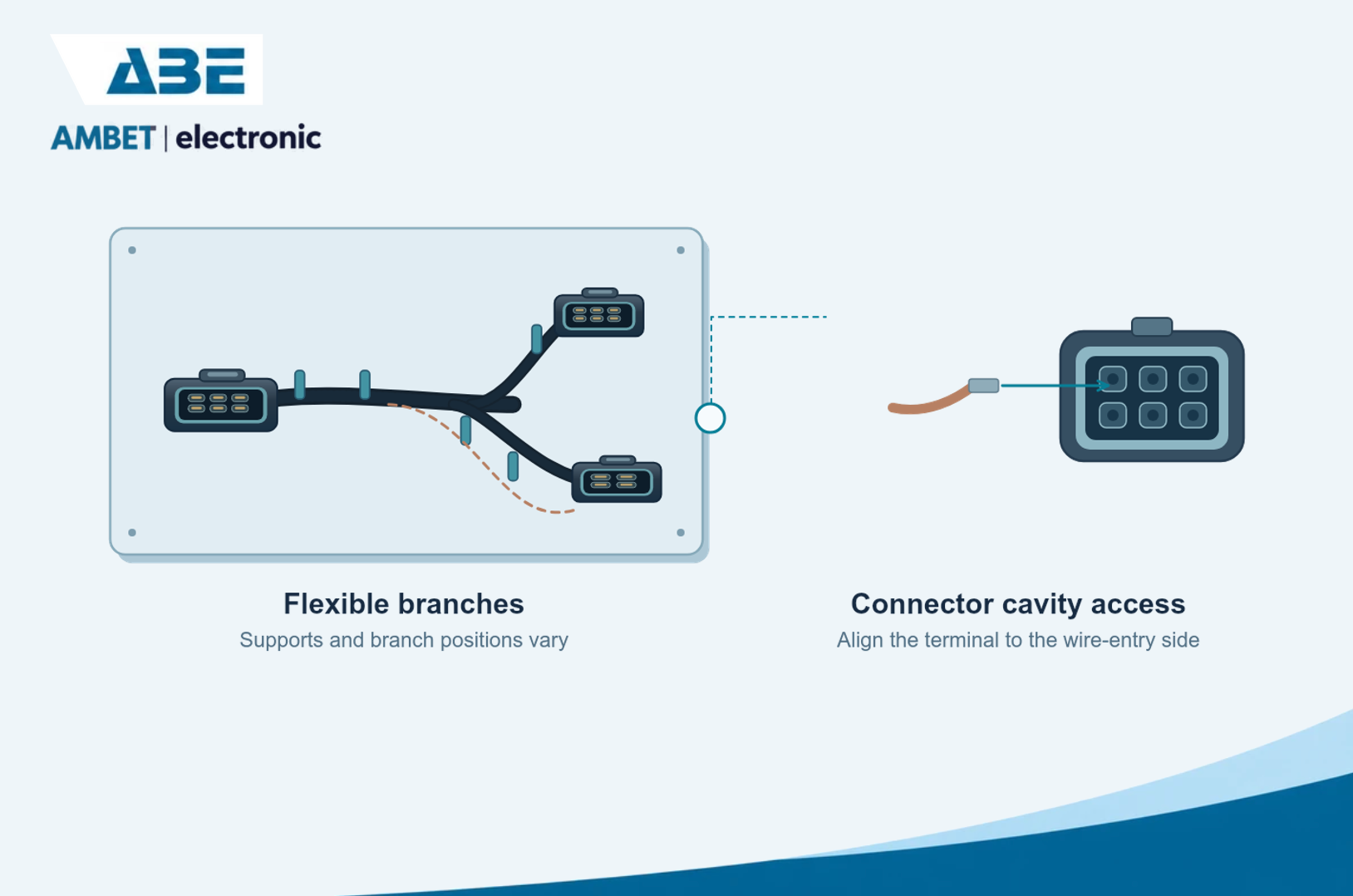
A wire does not maintain a fixed shape when it is picked up. One end may be held securely while the rest bends or twists under its own weight.
The challenge becomes greater when several wires are combined into a bundle. Moving one branch can change the position or available slack of another branch.
For example, a vehicle harness may have a long main trunk and several short branches for sensors, lamps, or other electrical devices. Each branch must reach its intended position without pulling other wires away from their routing points.
An automated system needs to locate the relevant wire, grip it without damage, control its movement, and verify that it has been placed correctly. Research into routing a flexible wire3 demonstrates how specialized robotic systems can address these challenges using controlled handling and fixtures.
An operator can adapt hand movements to the actual position of the bundle. This flexibility remains useful when the assembly has complicated geometry or frequent design changes.
However, the operator must still follow approved routing and assembly instructions. Flexibility is not a reason to accept inconsistent dimensions.
Why Is Terminal Insertion Into Connectors Difficult?
A connector housing is relatively rigid, but the crimped wire attached to its terminal is flexible.
The terminal must enter the correct cavity in the specified orientation. It must also seat and lock properly without damaging the contact or housing.
Several factors can complicate this operation:
- Small cavities and different terminal geometries.
- Wire movement that changes the insertion angle.
- Seals and locking features that affect insertion.
- Limited access as other cavities become occupied.
- Different cavity assignments across similar connector variants.
Automatic insertion systems are available for suitable configurations. The equipment needs reliable part presentation, positioning, and verification methods for the selected components.
Terminal seating and retention need to be verified regardless of the insertion method. A neatly arranged connector does not prove that every terminal has reached its correct position.
What Changes When a Line Runs Multiple Harness Variants?
Custom wire harness projects often involve more than one part number. Related assemblies may use the same housing but different wire lengths, pinouts, or branch arrangements.
Imagine an industrial machine with two versions. The first uses a standard control harness. The second adds a sensor that requires two extra wires, another branch, and a different cavity assignment.
| Design detail | Standard version | Sensor-equipped version |
|---|---|---|
| Main connector | Same housing | Same housing |
| Wire set | Standard circuits | Additional sensor circuits |
| Branch layout | Original branches | One additional branch |
| Pinout | Original cavity assignments | Revised assignments |
| Assembly instructions | Standard revision | Variant-specific instructions |
This is an illustrative example, not an actual AMBET project.
The manufacturer must identify the correct variant before selecting materials or preparing the assembly board. An automated cell may need different settings, part presentation, or fixtures. A guided manual station may handle the change through controlled kits and instructions, provided that the relevant checks are in place.
For customers ordering several similar harnesses, the manufacturer should explain how it prevents variants from being mixed. The correct work order, component list, pinout, and test program should all refer to the same approved configuration.
When Does More Assembly Automation Make Sense?
Automation can improve repeatability and productivity, but the most advanced equipment is not always the most practical choice for a custom harness project.
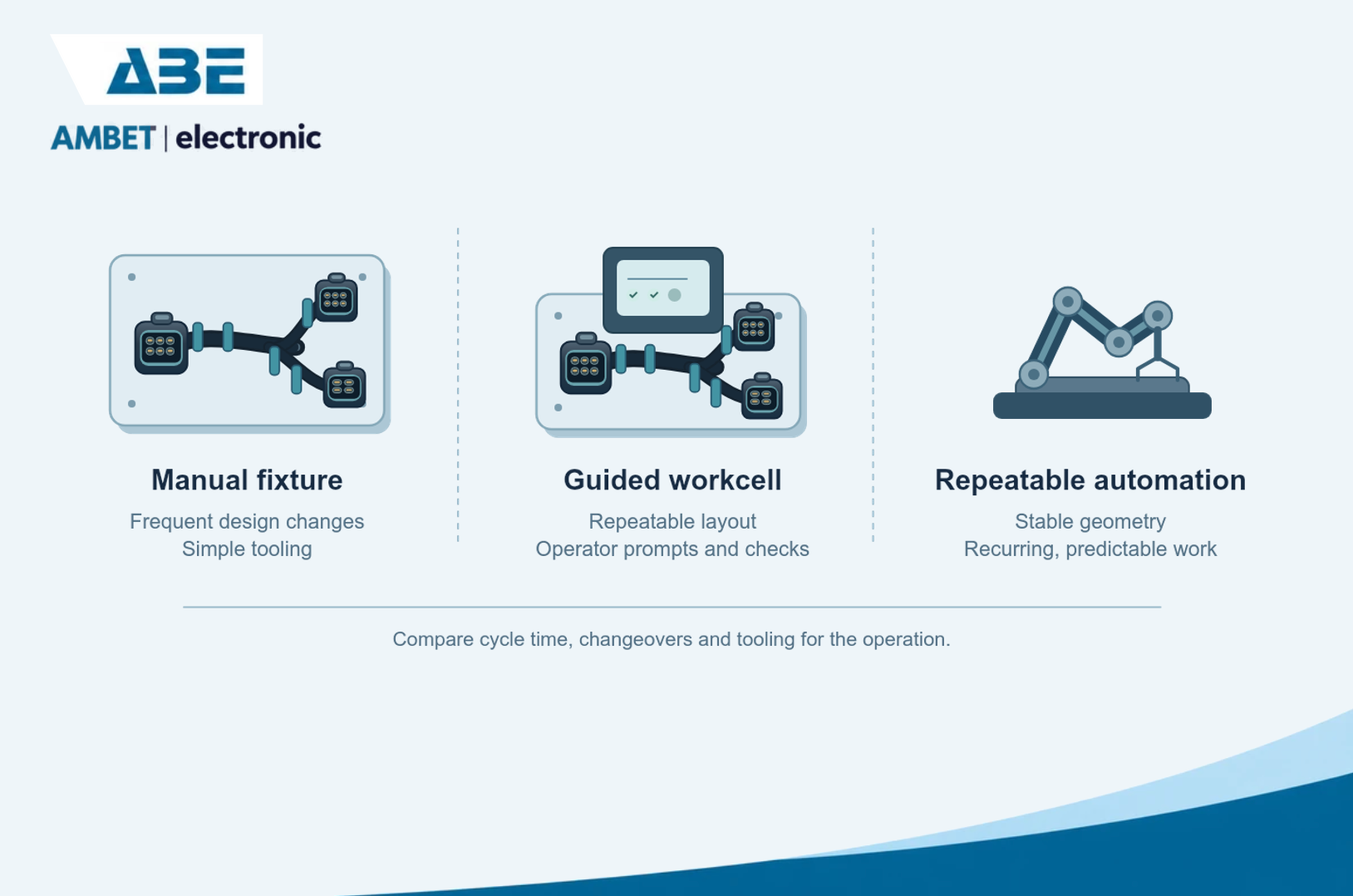
More automation makes sense when production operations are stable, repeatable, and economically justified. Manufacturers should consider volume per variant, product complexity, tooling investment, changeover time, and the ability to verify quality.
Which Repeated Operations Are Good Candidates?
Before investing in automation, the manufacturing team should identify which operations cause the greatest production difficulty. Is the problem slow wire preparation, incorrect terminal selection, inconsistent crimping, or variation in branch dimensions?
Each problem may require a different solution.
If a factory repeatedly processes the same wire and terminal combinations, automated preparation can reduce repetitive handling. If operators frequently select the wrong wire for a connector, a guided station or verified material kit may be a more practical first improvement.
For a stable harness design, dedicated fixtures or specialized assembly equipment may reduce handling time. For a project undergoing frequent revisions, the manufacturer may need a more flexible process until the design is established.
The best production approach depends on the individual operation, not just the total number of machines in the factory.
How Should Buyers Compare Volume, Changeovers, and Tooling?
An automatic machine requires more than the initial equipment purchase. A production setup may also need applicators, fixtures, programming, maintenance, spare parts, and validation.
Order volume alone can be misleading. Consider two hypothetical orders:
| Order characteristic | Project A | Project B |
|---|---|---|
| Total quantity | 10,000 assemblies | 10,000 assemblies |
| Number of variants | 1 | 20 |
| Quantity per variant | 10,000 | 500 each |
| Design changes | Infrequent | More frequent |
| Setup considerations | One stable configuration | Multiple configurations and changeovers |
Even though both projects have the same total quantity, their automation economics can differ. If Project B uses common wire and terminal combinations, it may still benefit from shared automated preparation. Its final assembly may require more frequent adjustments to fixtures and work instructions.
When requesting a quotation, share expected quantities by part number, order frequency, and design stability. These details help the manufacturer evaluate whether dedicated tooling or a flexible assembly process is more suitable.
For buyers, the quotation should also distinguish one-time tooling charges from recurring unit costs and clarify who owns any dedicated tooling.
How Do Manual, Semi-Automated, and Automated Assembly Compare?
The choice is rarely between a completely manual factory and a completely automatic one. Many production lines combine several methods.
| Production approach | Potential advantage | What buyers should verify |
|---|---|---|
| Manual assembly on a fixture | Flexibility for complex or changing designs | Work instructions, operator training, dimensional control |
| Guided workcell | More structured material and assembly selection | Correct variant identification and response to errors |
| Semi-automated operations | Repeatable processing with operator involvement | Setup approval and consistent part presentation |
| Dedicated automation | Potential for high repeatability and throughput | Supported variants, maintenance, and changeover validation |
For an aftermarket distributor ordering several replacement harness models, flexibility can be particularly valuable. For an OEM placing repeated orders for one stable product, dedicated automation may be easier to justify.
These are not universal rules. The supplier should assess the actual design and manufacturing requirements before proposing a process.
True or False:
A fully automated assembly process is always cheaper than a partly manual one.
False.
Automation can reduce repetitive labor, but tooling, programming, changeovers, maintenance, and validation also affect costs. The economic result depends on order volume, product mix, and design stability.
How Can Buyers Verify Quality on a Partly Manual Assembly Line?
Some buyers worry that manual assembly will lead to inconsistent products. The important question is how the manufacturer controls the work at each production stage.
Buyers should verify operator instructions, approved materials, fixture accuracy, crimp quality, terminal retention, electrical testing, and lot traceability. A partly manual assembly line can produce reliable harnesses when its processes and inspection requirements are properly controlled.
What Should a Controlled Build Show on the Shop Floor?
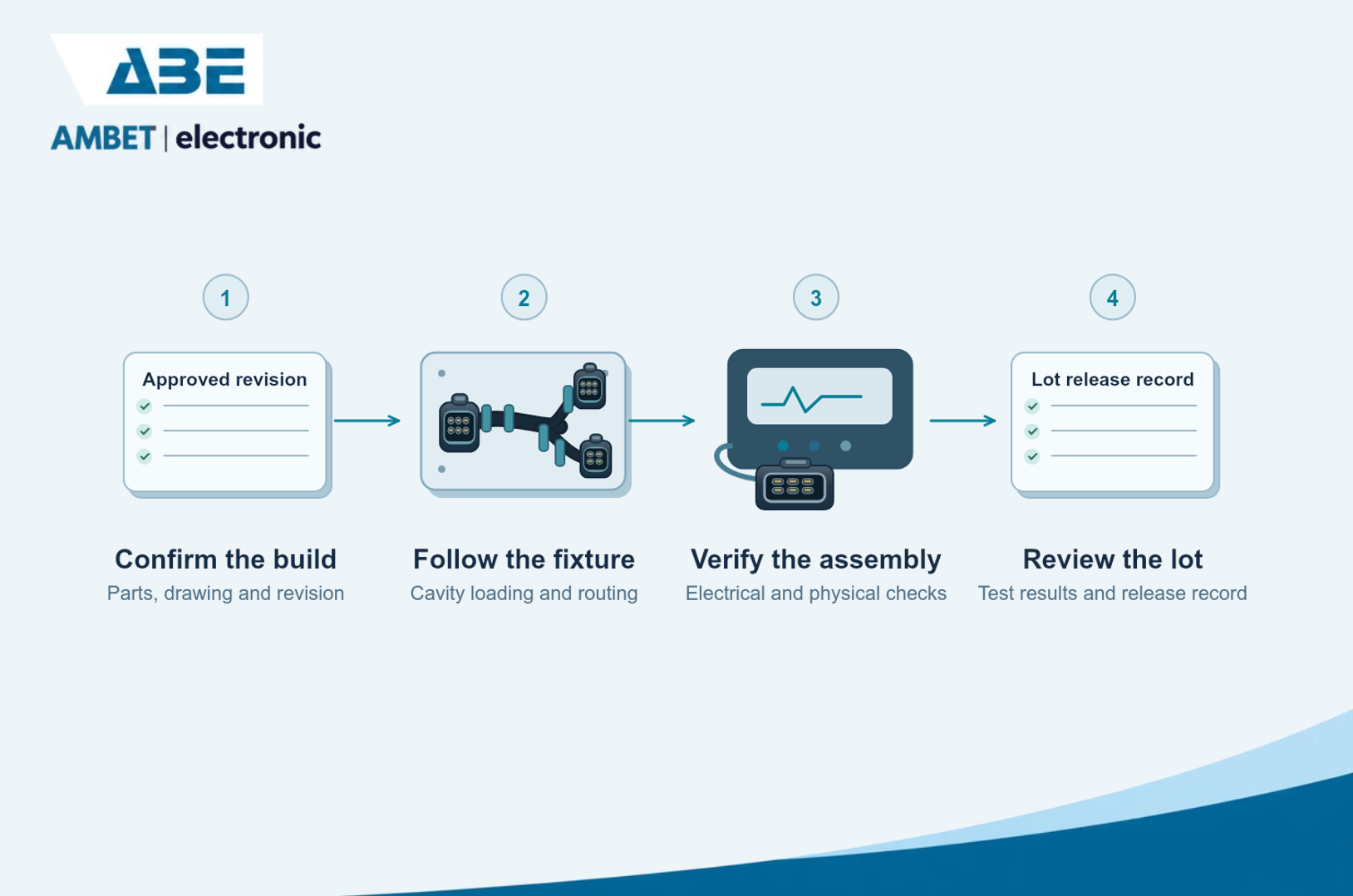
A factory visit is more informative when buyers follow one representative harness from the approved drawing to the finished assembly rather than simply count automatic machines.
First, check how the factory identifies the correct wires, terminals, connectors, and accessories. Similar components should not be mixed simply because they look alike.
Next, review the work instructions. Operators need to know the required assembly sequence, cavity assignments, branch dimensions, clip positions, and protection coverage.
A controlled build should also show what happens when something goes wrong. For example, if a terminal does not seat correctly, the operator should have an established way to hold the affected assembly for inspection rather than force the terminal into position.
The following areas help buyers assess process control during a factory visit:
| Control area | What to look for |
|---|---|
| Material preparation | Correct part numbers and approved component combinations |
| Work instructions | Current revision and clear assembly sequence |
| Crimping setup | Suitable tooling and required crimp measurements |
| Formboard | Defined connector, branch, and clip positions |
| Terminal insertion | Correct cavity assignments and seating checks |
| In-process inspection | Checks before tape or sleeves hide important features |
| Nonconforming products | Identification, segregation, and controlled disposition |
These controls matter whether the operation is manual or automatic. An incorrect machine setting can repeat the same defect across many wires, while an unclear manual instruction can lead to inconsistent assembly.
Which Inspections and Records Should Support Lot Release?
Electrical testing is an important final quality check. A pin-to-pin electrical test4 can compare the finished connections with an approved circuit map and detect wiring errors within the test system's coverage.
However, electrical testing alone cannot confirm that every mechanical requirement has been met. A harness may have correct electrical connections but an incorrectly positioned clip or a branch that is too short.
The inspection plan should therefore cover the relevant electrical and mechanical characteristics separately.
| Inspection | What it helps verify |
|---|---|
| Crimp height measurement | Conductor crimp dimensions |
| Crimp pull testing | Mechanical strength of sampled terminations |
| Visual inspection | Assembly condition and visible defects |
| Dimensional inspection | Overall length, branches, and mounting features |
| Electrical testing | Continuity, shorts, opens, and wiring accuracy within the defined coverage |
| Lot release review | Completion of the agreed inspection and release requirements |
At AMBET, each harness undergoes the applicable key electrical checks, such as continuity and checks for miswires, shorts, or opens. Crimp measurements, visual checks, dimensional checks, and other tests follow the control plan and order requirements. We review each production lot for quality release.
Please confirm the records you need for your specific order with our team before production. Individual test reports, additional mechanical tests, or special reporting formats should be discussed as project requirements rather than assumed.
What Questions Should Buyers Ask About Manual Assembly?
Before approving a supplier for repeat orders, buyers should establish how the proposed production method will work for their specific harness.
- Which operations will be automated, machine-assisted, or performed manually?
- How do you train operators and verify the approved setup?
- How do you prevent incorrect terminal insertion and mixed variants?
- Which characteristics are inspected before protective coverings are installed?
- How do you verify the electrical test program against the approved pinout?
- How do you record production changes and trace affected lots?
- Can the same approved configuration be reproduced after a production changeover?
For custom harness projects, these questions are more useful than asking for a general factory automation percentage. The answers should relate to the specific assembly, its risks, and the agreed acceptance criteria.
True or False:
Manual wire harness assembly necessarily produces lower-quality products than automated assembly.
False.
Quality depends on the suitability and control of the manufacturing process. Both manual and automated operations require correct materials, validated methods, inspection, and effective handling of defects.
Conclusion
Evaluate wire harness manufacturers by process control, product suitability, and verified quality rather than automation level alone. Manual and automated operations can work together effectively.
Shows an equipment example that combines cut-to-length, stripping, and crimping for supported wires and terminals. ↩
Shows how a full-scale formboard can mark the harness route and locate assembly fixtures. ↩
Describes the handling and configuration challenges researchers encountered when separating and routing flexible harness branches. ↩
Provides an industrial case of a pin-to-pin continuity fixture detecting swapped wires and recording test results. ↩